|
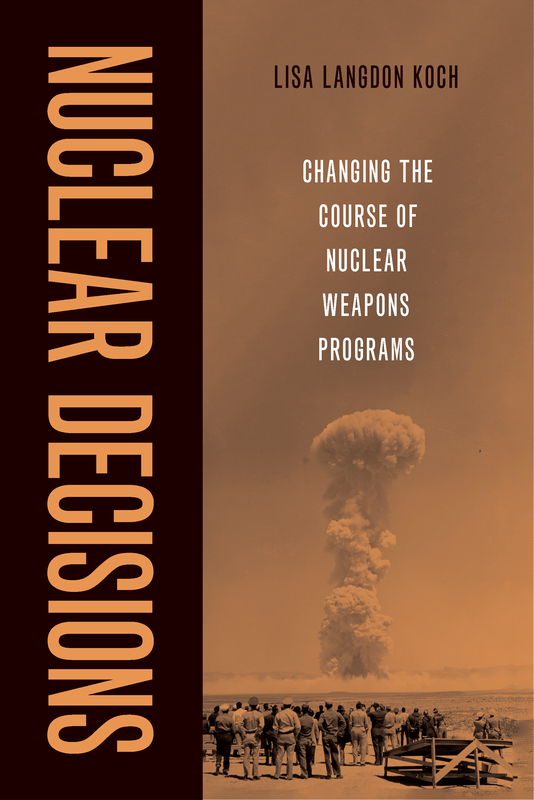
Nuclear Decisions: Changing the Course of Nuclear Weapons Programs Robert Jervis Best International Security Book Award Throughout the nuclear age, states have taken many different paths toward or away from nuclear weapons. These paths have been difficult to predict and cannot be explained simply by a stable or changing security environment. We can make sense of these paths by examining leaders’ nuclear decisions. |

|
Whether a state acquires nuclear weapons depends to a large extent on nuclear decisions: the political decisions state leaders make to accelerate or reverse progress toward nuclear weapons.
This book offers a theory of nuclear decision-making that identifies factors that shape leaders’ understandings of the costs and benefits of their nuclear pursuits. First: If the conditions are right, domestic experts in the nuclear scientific organization or military influence a leader’s nuclear decision-making. Second: in three different proliferation eras, changes to international political and structural conditions have constrained or freed states and leaders pursuing nuclear weapons development. |
Scholars and practitioners will gain new insights from case studies of nine states across the three eras. Through this global approach to studying nuclear proliferation, this book pushes back against the conventional wisdom that determined states pursue a straight path to the bomb.
Instead, nuclear decisions define a state’s nuclear pursuits.
REVIEWS
“Nuclear Decisions is an invaluable contribution . . . [Koch] provides careful, reasoned, and thoughtful critiques of the existing literature and makes the case that her theoretical approach provides more compelling explanations for both the pursuit and termination of nuclear weapons programs.” -- Šumit Ganguly, The Nonproliferation Review
"[Koch's] case studies are most valuable in tracing the interplay of bureaucratic and individual preferences as they are mediated by the political structure of each proliferating state. . . . her theoretical approach produces a more satisfactory explanation for proliferation patterns than security-focused accounts. The choice of including lesser-known cases of states . . . such as Sweden and South Korea makes this book easily recommendable as an introduction to historical proliferation cases." -- Xiaodon Liang, Arms Control Today
"Koch’s Nuclear Decisions is an important addition to the scholarship on nuclear proliferation. Her argument usefully combines both structural and domestic factors and her empirical work offers historical richness many will enjoy reading." -- Rachel Elizabeth Whitlark, H-Diplo
"Nuclear Decisions remains a valuable addition to the nuclear security literature and required reading for those that study the nature or domestic politics of nuclear weapons programs." -- Christopher J. Watterson, Journal for Peace and Nuclear Disarmament
“[Koch] made a complex subject readable . . . policy makers can now understand what the major influences are and devise strategies . . . the book is a wonderful survey of national nuclear weapons programs—including some less familiar pursuits such as Sweden’s.” – Mark L. Maiello, Journal of Nuclear Materials Management
“Nuclear Decisions . . . for the many wonks among us fascinated by a world graced with nine nuclear-armed nations. We ask: why nine, so many? Why not many more? Academics keep pumping out books with different theories but most are hardly entertaining. Nuclear Decisions does entertain . . . [it] is a dazzling treat for those ordinary people like us puzzling about the nuclear threat.” -- Read Listen Watch
"Koch offers a theory of nuclear proliferation that explains a state’s pursuit of nuclear arms not as a single decision driven by security concerns but as a series of decisions informed by both the external environment and domestic bureaucratic politics . . . the book is a welcome addition to the international relations theoretical literature . . ." -- Choice
Instead, nuclear decisions define a state’s nuclear pursuits.
REVIEWS
“Nuclear Decisions is an invaluable contribution . . . [Koch] provides careful, reasoned, and thoughtful critiques of the existing literature and makes the case that her theoretical approach provides more compelling explanations for both the pursuit and termination of nuclear weapons programs.” -- Šumit Ganguly, The Nonproliferation Review
"[Koch's] case studies are most valuable in tracing the interplay of bureaucratic and individual preferences as they are mediated by the political structure of each proliferating state. . . . her theoretical approach produces a more satisfactory explanation for proliferation patterns than security-focused accounts. The choice of including lesser-known cases of states . . . such as Sweden and South Korea makes this book easily recommendable as an introduction to historical proliferation cases." -- Xiaodon Liang, Arms Control Today
"Koch’s Nuclear Decisions is an important addition to the scholarship on nuclear proliferation. Her argument usefully combines both structural and domestic factors and her empirical work offers historical richness many will enjoy reading." -- Rachel Elizabeth Whitlark, H-Diplo
"Nuclear Decisions remains a valuable addition to the nuclear security literature and required reading for those that study the nature or domestic politics of nuclear weapons programs." -- Christopher J. Watterson, Journal for Peace and Nuclear Disarmament
“[Koch] made a complex subject readable . . . policy makers can now understand what the major influences are and devise strategies . . . the book is a wonderful survey of national nuclear weapons programs—including some less familiar pursuits such as Sweden’s.” – Mark L. Maiello, Journal of Nuclear Materials Management
“Nuclear Decisions . . . for the many wonks among us fascinated by a world graced with nine nuclear-armed nations. We ask: why nine, so many? Why not many more? Academics keep pumping out books with different theories but most are hardly entertaining. Nuclear Decisions does entertain . . . [it] is a dazzling treat for those ordinary people like us puzzling about the nuclear threat.” -- Read Listen Watch
"Koch offers a theory of nuclear proliferation that explains a state’s pursuit of nuclear arms not as a single decision driven by security concerns but as a series of decisions informed by both the external environment and domestic bureaucratic politics . . . the book is a welcome addition to the international relations theoretical literature . . ." -- Choice